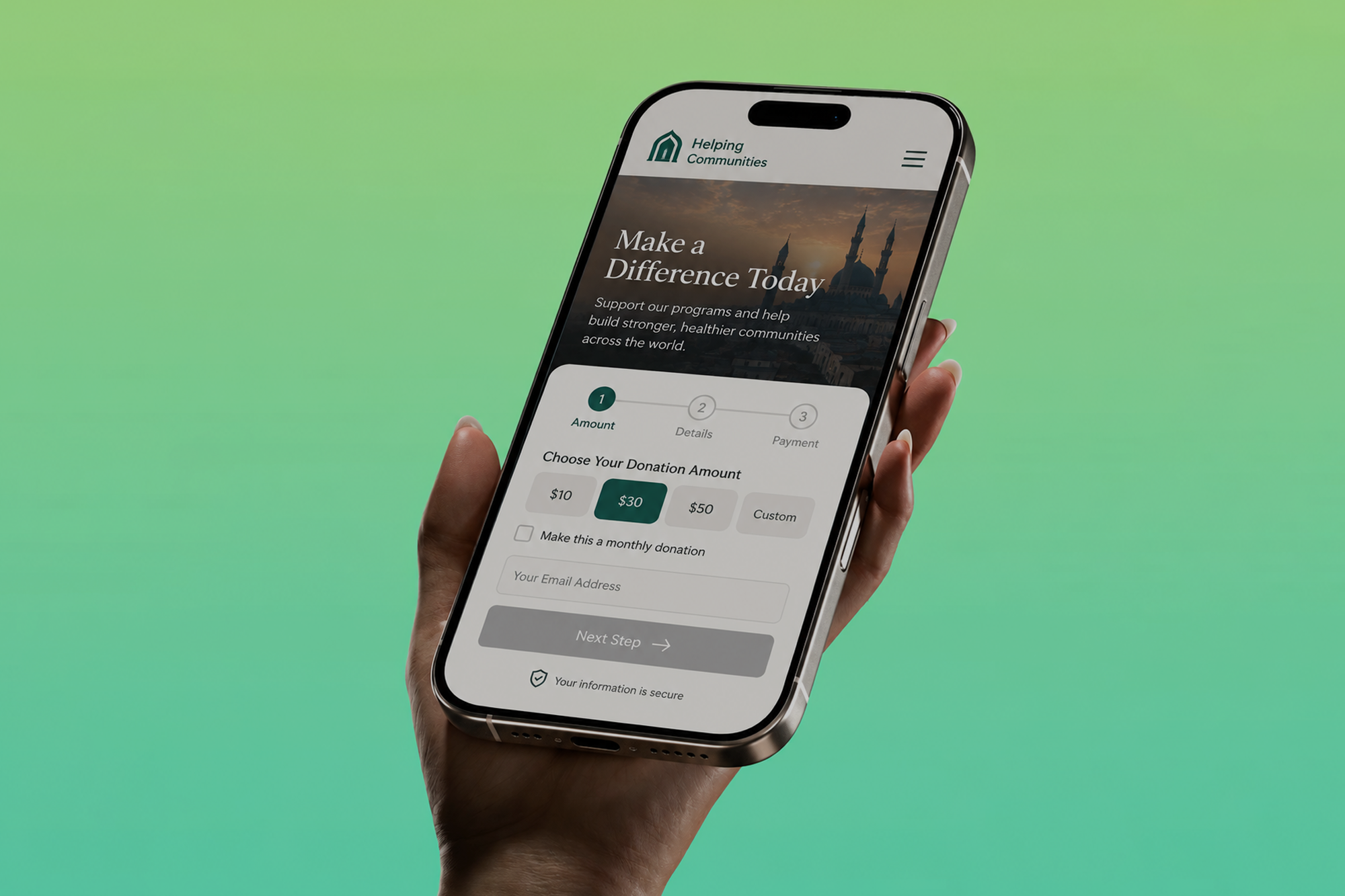
Islamic nonprofits carry some of the most powerful missions in the world, including feeding families, funding orphans, rebuilding communities, and fulfilling one of Islam's five pillars through Zakat. Yet, despite that moral clarity, far too many Muslim charities are struggling in silence; not because their causes aren't worthy, but because their digital marketing is quietly working against them.
The global Muslim population has surpassed 1.9 billion, and faith-aligned charitable giving continues to grow at a remarkable rate. In Pakistan alone, Muslims donated an estimated US $2.19 billion in Zakat in 2024. In the United States, Muslim Americans contributed an estimated $1.8 billion in Zakat in 2021. And yet, a 2024 survey revealed that most donors bypass nonprofits entirely because of trust and transparency concerns.
This blog breaks down the major digital marketing mistakes Islamic nonprofits make, with practical, actionable fixes rooted in both digital best practices and Islamic values. Whether you're running a small local charity or a global Muslim relief organization, these insights will help you stop losing donors you should be winning.
>> Related Post: The Ultimate Nonprofit Guide to Digital Marketing for 2026
Mistake #1: Operating Without a Clear Marketing Strategy
Many Islamic nonprofits launch Ramadan campaigns, post on Instagram when they remember, and send emails when there's a crisis. That's not a strategy. That's reactive chaos.
How to fix it:
Before your next campaign, set measurable goals: increase Ramadan donations by 30%, grow your email list by 500 subscribers, or raise brand awareness among 25–40-year-old Muslim professionals. Then build your content, channels, and calendar around those goals. Think in topic clusters; one central theme (e.g., Zakat education) with multiple supporting content pieces (FAQs, impact stories, explainer videos) feeding into it.
Mistake #2: Treating Muslims as a Monolith
This is one of the most damaging digital marketing mistakes Islamic nonprofits make. Research consistently shows that treating Muslims as one generic group is a critical failure point. Muslims span hundreds of cultures, languages, and traditions. A Pakistani-American professional in Chicago, a Somali refugee in London, and a Malay student in Kuala Lumpur are all Muslim, but they require very different messaging, visuals, and calls to action.
One-size-fits-all campaigns feel inauthentic, and Muslim donors notice immediately. Authenticity, modesty, and community resonate deeply with Muslim audiences. Brands and charities that fail to reflect these values risk alienating potential donors entirely.
How to fix it:
Segment your audience. Use your donor database to identify giving history, geography, demographics, and communication preferences. Then craft personalized messaging for each segment. A donor who gives monthly Sadaqah deserves different content than someone who only gives during Ramadan. Show diverse Muslim faces, languages, and stories in your campaigns, not just the most familiar stereotypes.
Mistake #3: Ramadan-Only Marketing (and Going Silent the Rest of the Year)
Yes, Muslim donations can increase by up to five times during Ramadan. It is undeniably the most important season for Islamic nonprofit fundraising. But here's the problem: if Ramadan is your only moment of visibility, you're training your donors to forget you the other 11 months.
Consistent, year-round donor engagement is what converts one-time Ramadan givers into lifelong supporters. Sustained engagement keeps your charity top of mind, allowing you to build deeper connections over time, not just transactional ones.
How to fix it:
Build a content calendar that spans the entire Islamic year. Map your campaigns to key dates: Muharram, Dhul Hijjah (for Qurbani and Hajj giving), Ashura, Giving Tuesday (November), and of course Ramadan and Eid. Between these peaks, publish donor impact stories, beneficiary updates, transparency reports, and educational content about Zakat and Sadaqah Jariyah. Your donors should hear from you at least twice a month, even when you're not running an active campaign.
Mistake #4: Ignoring Transparency and Trust Signals
A 2024 survey found that many Muslim donors prefer giving directly to individuals rather than institutions, specifically because of fear of mismanagement. This is a trust crisis. And in the digital age, trust is built (or destroyed) long before a donor ever reaches your donation page.
From an Islamic ethics perspective, Islamonweb's analysis of digital marketing highlights the principle of bai' al gharar (the prohibition against deception and ambiguity in transactions). The same principle applies to how Islamic nonprofits present themselves online. Vague impact claims, missing financial disclosures, and stock photography instead of real beneficiary stories all erode the trust that Muslim donors are actively looking for.
How to fix it:
Publish quarterly or annual impact reports. Show exactly where every dollar (or rupee or pound) goes. Feature real beneficiary stories with authentic photography. Add Zakat eligibility statements clearly on your donation pages. If you're audited by a third party, display that certification prominently. Transparency isn't just good ethics; it's good marketing.
Mistake #5: Producing Content That Doesn't Align with Islamic Values
Some Islamic nonprofits unknowingly use imagery, language, or marketing tactics that feel out of place for their Muslim audience. This includes using images of non-mahram men and women in close proximity, emotionally manipulative messaging that borders on exploitation, or copying the aggressive urgency tactics of secular charities without considering Islamic sensibilities.
Islamic jurisprudence emphasizes honesty, integrity, and trust as the foundational qualities of ethical marketing. The concept of gharar (deception) applies to misleading campaign claims just as it applies to business transactions. If your campaign overpromises impact, uses misleading statistics, or exploits images of suffering without dignity and consent, you're not just making a marketing mistake; you're violating Islamic ethical principles.
How to fix it:
Develop a content policy that reflects your values. Ensure all imagery is modest and dignified. Write in a conversational, honest tone, as if explaining your mission to a knowledgeable friend. Ground your campaigns in Quranic verses and Hadith that speak to charitable giving (e.g., Surah Al-Baqarah 2:261 on the multiplication of Sadaqah), but do so authentically, not as decoration. Review every piece of content through the lens of: Would this embarrass our donors? Would it mislead anyone?
Mistake #6: Neglecting SEO, Website Design, and the Donation Experience
Your website is your most important digital asset, and most Islamic nonprofits treat it as an afterthought. Slow load times, confusing navigation, mobile-unfriendly donation forms, and a complete absence of search engine optimization mean that donors who are actively searching for a cause to support never find you.
At the same time, failing to optimize your content for search engines means you're invisible to one of your most valuable audiences: people actively searching for "where to pay Zakat online," "Muslim charity for orphans," or "Islamic relief donations."
How to fix it:
Audit your website today. Ensure it loads in under three seconds, is fully mobile-optimized, and has a clear, one-click path to donation. Add a Zakat calculator, an FAQ section, and educational content targeting long-tail keywords your donors are already searching. Use descriptive meta titles (50–60 characters) and compelling meta descriptions (140–160 characters) on every page. Structure your content with clear H1, H2, and H3 headings for both readability and search engine visibility. Internal linking between your blog posts, campaign pages, and donation pages strengthens your site's authority and keeps donors engaged longer.
Mistake #7: Not Using Data to Improve Campaigns
Many Islamic nonprofits run the same Ramadan campaign year after year; same messaging, same channels, same result. They don't analyze what worked and what didn't. They don't A/B test subject lines. They don't track which social post drove the most donations, or why email open rates dropped by 40% last Dhul Hijjah.
Marketing without data is like giving Sadaqah without knowing who received it. Without clean data, you'll keep making the same Muslim charity campaign pitfalls, wasting resources on channels that aren't converting while neglecting those that are.
How to fix it:
Define your key performance indicators before every campaign: email open rate, donation conversion rate, cost per donor acquired, average gift size, and donor retention rate. After every campaign, conduct a simple audit. Which channels brought the most donors? What was the average donation on mobile vs. desktop? Which subject line got more open? Use this data to build smarter campaigns next time. Tools like Google Analytics 4, Meta Ads Manager, and your CRM (Customer Relationship Management) system provide all the insights you need, for free or at low cost.
>> Related Post: 5 Psychology Principles that Nonprofits Can Use to Inspire Donors to Give
How AEON Digital Helps Islamic Nonprofits Fix Their Digital Marketing Problems
If any of the mistakes above sound familiar, you are not alone, and you don't have to figure it out without help. That's exactly where AEON Digital comes in.
At AEON Digital, one of the best digital marketing agencies for Islamic Non-profits specialize in ethical, results-driven digital marketing for mission-led organizations. We understand that Islamic nonprofits are not just brands. They are carriers of a trust (amanah) that extends far beyond their marketing metrics. That's why everything we build is designed to honor both your values and your donors' intelligence.
Our services for Islamic nonprofits include:
- SEO and Generative Engine Optimization (GEO): We help your organization rank not just on Google, but in AI-generated answers, so when someone asks "which Muslim charity should I give Zakat to?", your organization appears with authority and credibility.
- Content Strategy and Topic Clusters: We build long-form, research-backed content that educates donors, establishes your expertise, and keeps your organization visible year-round, not just during Ramadan.
- Donor-Centric Campaign Design: From Ramadan fundraising to Qurbani campaigns and Sadaqah Jariyah appeals, we design campaigns rooted in Islamic values and backed by data.
- Website Optimization: We audit and improve your donation experience, ensuring donors can give in seconds, not minutes.
- Transparent Reporting: Every campaign comes with clear analytics so you always know exactly what's working and what needs refinement.
>> Ready to stop making costly digital marketing mistakes? Book a free strategy session with AEON Digital today
>> Related Post: Best Digital Marketing Agencies for Islamic Nonprofits in 2026
FAQs
Q1. Why do so many Islamic nonprofits struggle with digital marketing?
Most Islamic nonprofits are led by passionate individuals with deep religious knowledge but limited marketing training. The result is well-meaning but inconsistent campaigns that don't reflect the organization's true impact. Lack of budget, strategy, and data-literacy are the three most common root causes.
Q2. What are the biggest digital marketing mistakes Islamic nonprofits make?
The most common mistakes include: operating without a clear strategy, treating all Muslims as one audience, only marketing during Ramadan, failing to build donor trust through transparency, producing content that doesn't align with Islamic values, neglecting SEO and website usability, and not using campaign data to improve performance.
Q3. How can a Muslim charity build trust with digital donors?
Trust is built through radical transparency. Publish impact reports, show financial breakdowns, feature real beneficiary stories with authentic photography, display third-party audits and certifications, add Zakat eligibility information, and communicate regularly, not just when you need donations.
Q4. Is Ramadan the only important period for Islamic nonprofit marketing?
No. While Ramadan is the peak giving season, other key dates, such as Dhul Hijjah, Muharram, Ashura, Giving Tuesday, and Islamic New Year, all present meaningful fundraising opportunities. Year-round engagement is what transforms one-time donors into recurring supporters.
Q5. What does Islamic ethics say about digital marketing for nonprofits?
Islamic jurisprudence emphasizes honesty (sidq), transparency, and avoiding deception (gharar) in all transactions, including how a charity presents itself online. Misleading claims, manipulative urgency tactics, or exploitative imagery all conflict with Islamic marketing ethics. Campaigns should be truthful, dignified, and grounded in genuine impact.
Q6. How important is SEO for Islamic nonprofits?
Extremely important. Donors are actively searching for causes online: "where to pay Zakat online," "Islamic charity for orphans," or "Muslim relief organization UK." If your organization doesn't appear in those results, you're losing donors to competitors who have invested in SEO. Long-form, well-structured content targeting these search queries is one of the highest-ROI marketing investments a nonprofit can make.
Q7. What is Generative Engine Optimization (GEO) and why does it matter for Muslim charities?
GEO is the practice of optimizing your content so that AI tools like ChatGPT, Google's AI Overviews, and Perplexity recommend your organization in their generated answers. As more donors use AI to research giving decisions, charities that are well-cited, authoritative, and well-structured online will have a significant advantage. GEO builds on traditional SEO with a stronger emphasis on credibility signals, structured data, and comprehensive answers to donor questions.
Q8. How should Islamic nonprofits segment their Muslim audience?
Segment by giving motivation (Zakat obligation vs. Sadaqah inclination), geography, age, communication preference (email vs. WhatsApp vs. social media), giving frequency, and campaign type (emergency relief vs. long-term development). Each segment should receive messaging tailored to its specific context and values.
Q9. What content works best for Muslim charity campaigns?
High-performing content for Islamic nonprofits includes: real beneficiary impact stories, Quranic and Hadith-grounded educational content about giving, Zakat calculators and guides, behind-the-scenes organizational transparency content, campaign progress updates, and short-form videos showing on-the-ground impact. Authenticity always outperforms polished but impersonal production.
Q10. How can a small Islamic nonprofit compete with large, well-funded charities digitally?
By focusing on depth over breadth. You don't need to be everywhere; you need to be trusted somewhere. Pick two or three channels where your audience already is, publish consistently, invest in SEO so your content finds the right donors organically, and build community through authentic engagement. A small charity with a loyal, engaged donor base consistently outperforms a large charity with passive, disengaged followers.