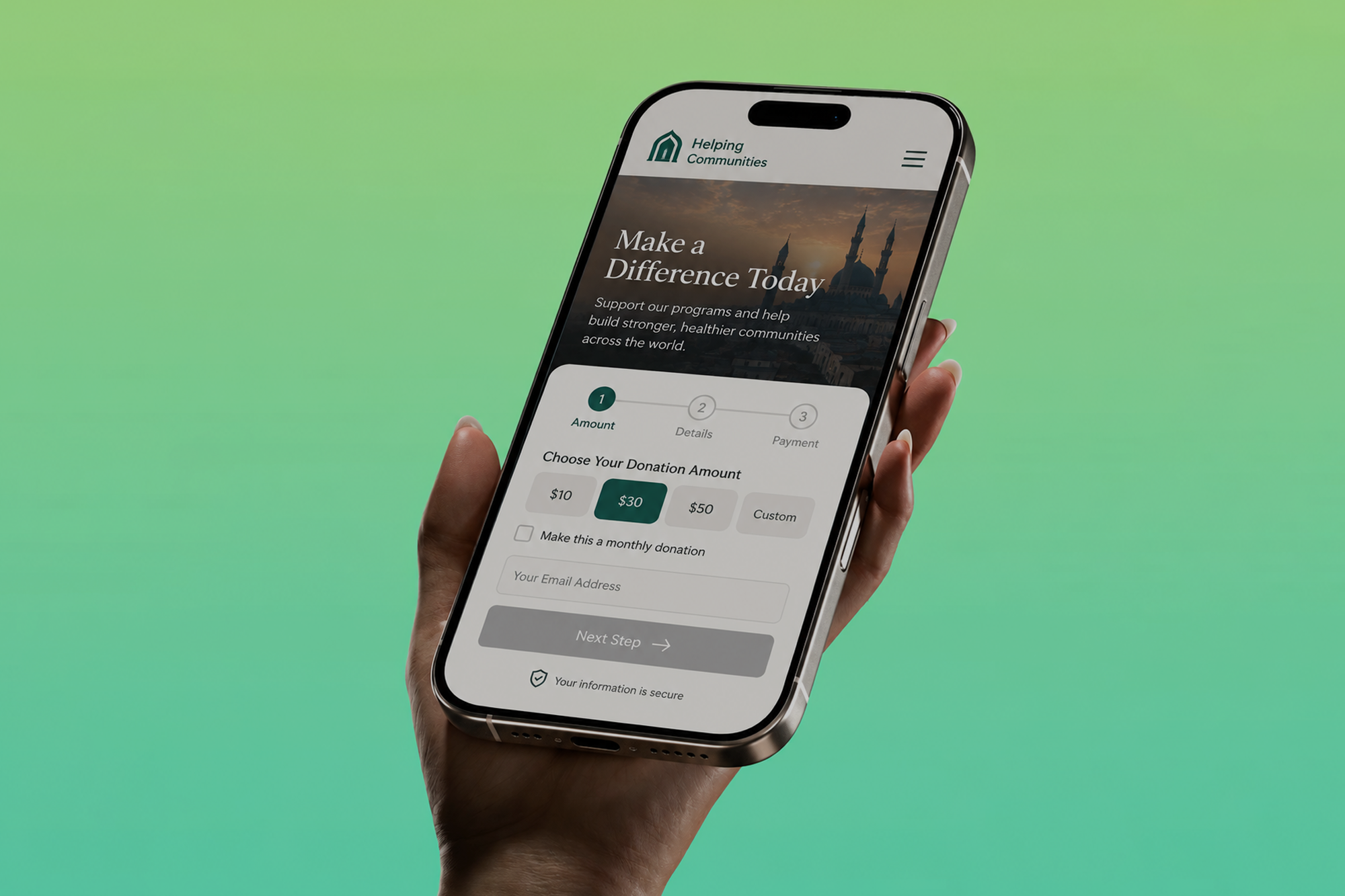
When a Muslim donor decides to give Zakat, Sadaqah, or Fidya online, they are not just completing a financial transaction. They are fulfilling a spiritual obligation, and the landing page that receives them either honors that intention or quietly turns them away. Islamic nonprofits running digital campaigns in 2026 are competing for attention during peak giving windows like Ramadan, Dhul Hijjah, and Eid, and a generic donation page simply does not cut it anymore. The organizations that are pulling ahead are the ones that understand Muslim donation landing page optimization as a discipline of its own, one that blends conversion science with Islamic values, cultural nuance, and genuine trust-building. If your campaign traffic is healthy but your donations are not matching it, the problem is almost certainly your landing page.
Why Muslim Donation Landing Page Optimization Is Not the Same as Standard Fundraising
Most landing page advice is built around commercial psychology: create urgency, reduce friction, drive the click. That framework works for selling products. It only partially works for Islamic nonprofit fundraising landing page design, because the Muslim donor is motivated by something far deeper than a limited-time offer. They are giving because their faith commands it, because they believe their wealth is a trust from Allah, and because the act of giving itself carries spiritual reward. A landing page that ignores this context is leaving both donations and trust on the table.
The mismatch shows up in specific ways. A generic fundraising page might lead with a dramatic photo and a countdown timer. An optimized Muslim donation landing page leads with purpose, clarity about where the money goes, and language that reflects the values of the donor. It acknowledges different types of Islamic giving, explains Zakat eligibility, and creates an experience that feels like a thoughtful invitation rather than a sales funnel. The World Congress of Muslim Philanthropists estimates that Muslims give between $200 billion and $1 trillion annually in Zakat alone, yet a significant portion of that giving still happens informally because donors do not trust digital platforms to handle it correctly. Your landing page is your first and most important answer to that concern.
The average nonprofit donation page conversion rate is just 11% on desktop and 8% on mobile. For Islamic nonprofits, where donor trust requires an extra layer of credibility and religious alignment, closing that conversion gap starts with rethinking the landing page from the ground up.
>> Related Post: Best Digital Marketing Agencies for Islamic Nonprofits in 2026
Landing Page Best Practices Muslim Donation Campaigns Must Follow in 2026/2027:
1. Lead With Intention, Not Just Emotion
The headline on your page is doing more work than you think. For a Muslim donor who has just searched "where to pay my Zakat online" or clicked through a Ramadan email campaign, the headline is the handshake. It needs to confirm that they are in the right place, that their giving will go where they intend, and that the organization understands what kind of giving they are here to do. "Pay Your Zakat Here" is stronger than "Donate Today" because it speaks to the niyyah, the intention, that the donor is already carrying. Your headline, subheading, and opening paragraph should speak directly to the type of giving the campaign is centered on. A Ramadan Sadaqah campaign and a Zakat campaign are not the same emotional experience for the donor, and the page should not pretend they are.
2. Make Giving Categories Unmistakably Clear
One of the fastest ways to lose a Muslim donor mid-page is ambiguity about how their gift will be categorized and distributed. Islamic charity donation page optimization means removing every reason for doubt before it forms. The best-performing Islamic fundraising pages include:
- Designation system: a visible selector so donors can choose Zakat, Sadaqah, Fidya, Kaffarah, Lillah, or Qurbani without digging through a FAQ
- Category descriptions: a brief plain-language explanation of each giving type that respects the donor's intelligence without requiring scholarly knowledge
- Zakat confirmation: eligibility stated directly on the form, not buried elsewhere on the page
- Fund transparency: a clear indication of which projects or regions each designation supports
This is not only good for conversion, it is also good Islamic practice. Clarity in the act of giving is itself encouraged.
3. Build Trust Through Sharia Compliance Signals
Trust is the single biggest conversion factor on a Muslim donation landing page, and it has to be earned visually, not just stated. A line at the bottom of the page that says "We are Zakat-eligible" is not enough. The trust signals need to be prominent, specific, and verifiable:
- Scholar names: display the names of Islamic scholars who have reviewed your Zakat distribution methodology
- Compliance policy: link to your Sharia compliance document directly from the donation page
- Quranic categories: show which of the eight categories your Zakat funds reach
- Endorsement placement: make scholar endorsements visible above the fold, not buried in an About section
- Registration details: include your charity registration number and a link to your financial transparency reports
When a recognized Islamic scholar confirms that an organization's Zakat distribution is compliant, that one line can do more for conversion than any amount of social proof badges.
4. Structure and Visual Hierarchy That Guides the Donor
A well-designed Islamic nonprofit fundraising landing page does not just look clean. It thinks on behalf of the donor. The structure should move the visitor from emotional connection at the top, through trust-building in the middle, to a frictionless giving experience at the bottom. Every section has a job, and no section should make the donor work harder than necessary to understand what is being asked of them.
The visual hierarchy matters because Muslim donors visiting campaign pages during Ramadan are often doing so late at night on a phone, after Tarawih prayers, in a moment of heightened spiritual awareness. This is not the moment for a page cluttered with auto-playing videos, pop-ups, and competing calls to action. It is the moment for a clear headline, a meaningful image or short story, designated giving options, a streamlined form, and one strong call to action. Simplicity is not a design limitation here. It is a conversion strategy.
Key Design Elements Your Page Needs
Every Islamic charity donation page should have the following in place before a campaign goes live:
- Campaign headline: name the specific giving type or season (Zakat, Sadaqah Jariyah, Ramadan, Dhul Hijjah)
- Compliance confirmation: Sharia compliance and Zakat eligibility visible above the fold
- Impact-anchored amounts: preset donation levels tied to real outcomes, for example "$50 feeds a family for a week"
- Giving category selector: a dropdown or button set for Zakat, Sadaqah, Fidya, Lillah, and Qurbani with plain-language descriptions
- Recurring giving option: framed around Sadaqah Jariyah so the donor understands its ongoing spiritual reward
- Beneficiary story: one specific person, family, or community, not a broad statistics block
- Mobile-optimized form: large tap targets and one-tap payment options like Apple Pay
- Trust section: scholar endorsement, registration details, and financial transparency links
- Post-donation message: in English and, where relevant, Arabic, acknowledging the spiritual significance of the act
5. Donation Amount Anchoring With Islamic Context
Preset donation amounts are standard on any fundraising page, but on a Muslim donation landing page, anchoring those amounts to Islamic giving concepts turns a transactional choice into a spiritually meaningful one. Instead of showing $10, $25, $50, and $100, show the donor what each amount means in an Islamic frame:
- $30 covers Fidya for one missed fast day
- $100 sponsors an orphan's education for one month as Sadaqah Jariyah
- $250 fulfills Zakat al-Fitr for a family of five
- $500 provides Qurbani for an entire family this Eid
That shift in framing transforms the decision from "how much should I give" to "which act of worship do I want to complete" and it has a direct impact on both conversion rate and average gift size. Aeon Digital has written in detail about donation ask amount best practices for nonprofits and it is worth reading alongside your page planning.
6. Mobile Optimization Is Not Optional
Over half of nonprofit website traffic now comes from mobile devices, yet mobile donation pages convert at a significantly lower rate than desktop. For Muslim donors specifically, a large proportion of peak Islamic giving happens on phones, late at night during Ramadan, during Dhul Hijjah, or immediately after Friday prayers. If your page does not load fast, respond beautifully on a small screen, and allow someone to complete a donation in under two minutes with their thumb, you are losing gifts at the exact moments when donor intent is at its highest. Your form should have no more than five fields for a first-time donor. Payment options should include digital wallets. Donation amount buttons should be large enough to tap without zooming. And the page should not redirect the donor to a third-party site mid-process unless that site is equally well-designed and trusted.
>> Related Post: Top 7 Digital Marketing Mistakes Islamic Nonprofits Make
Islamic Charity Donation Page Optimization During Peak Giving Seasons
1. Ramadan Campaign Pages Need a Different Urgency
Ramadan is the single highest-converting fundraising window for Islamic nonprofits globally, but urgency during Ramadan works differently than in commercial fundraising. The donor already feels the urgency. The month itself carries spiritual stakes. What your landing page needs to do is channel the energy the donor brings with them, not manufacture pressure. A page that leads with "Only 10 days of Ramadan left" is playing the wrong game. A page that says "Make the most of these blessed nights" is speaking the donor's language.
The practical implication for Islamic nonprofit fundraising landing page design is that your page should shift messaging across the three phases of Ramadan: mercy in the first ten days, forgiveness in the middle ten, and salvation and Laylat al-Qadr in the final ten. The donation amount anchors, the campaign story, and even the imagery can evolve with each phase. Organizations that treat Ramadan as a single static campaign leave conversion on the table that a phased approach would have captured.
2. Dhul Hijjah and Qurbani Campaign Considerations
Dhul Hijjah represents the second major peak giving window of the Islamic calendar, and Qurbani campaigns require their own landing page logic. A donor visiting a Qurbani page is not deciding whether to give. They are deciding where to give and whether they trust this organization to perform the sacrifice correctly, in the right countries, according to Sharia requirements. Your landing page must answer those questions before the donor has to ask them. This means showing where Qurbani meat is distributed, which regions are served, whether the sacrifice is performed by Islamic standards, and what confirmation the donor receives. Donors who give Qurbani are often giving on behalf of their entire household, which means the average gift value is higher, making the cost of a poor landing page experience proportionally more significant.
>> Related Post: How to Increase Online Donations for Your Islamic Charity
AEON Digital: The Partner Behind High-Converting Muslim Donation Landing Page Optimization
A well-structured landing page is only as powerful as the strategy behind it. AEON Digital was built to close exactly that gap, bringing together the technical precision of conversion optimization and the cultural depth that Islamic nonprofit fundraising demands. While most agencies apply generic best practices and hope they translate, AEON builds donation funnels from the ground up around Muslim donor psychology, Islamic giving seasons, and the trust signals that actually move faith-driven communities to act.
What makes AEON's approach different is integration. Muslim donation landing page optimization does not exist in isolation. It works best when the page is supported by SEO-driven traffic, a well-sequenced email donor journey, and paid media campaigns targeting warm audiences at the right moment. That is exactly how AEON builds. Every channel is coordinated, every campaign is timed around the windows that matter, and every landing page is designed to convert intent into action without compromising the values your donors expect.
>> Ready to See What Your Donation Page Is Really Doing? Claim your free landing page audit and find out exactly where your donors are dropping off.
FAQs
- What is the biggest reason Islamic charities struggle to grow online donations?
Most lack optimized donation pages, clear fund separation, mobile design, and donor follow-up.
- How should an Islamic charity separate Zakat and Sadaqah?
Create distinct funds with clear explanations. Zakat must follow Quranic categories; Sadaqah can support wider projects.
- How important is recurring giving online?
Recurring monthly Sadaqah builds stable revenue and reduces reliance on seasonal campaigns.
- Which digital channels work best for fundraising?
Email converts best, social builds awareness, WhatsApp drives community giving, and SEO sustains long-term traffic.
- How do you keep donors engaged outside Ramadan?
Share field updates, impact stories, and educational content year-round to keep donors connected.
- Does SEO matter for Islamic charity fundraising?
Yes. Ranking for Zakat and Sadaqah searches captures donors with high intent and builds lasting traffic.
- What should an email sequence look like after a first donation?
Send a receipt immediately, a project story within days, and introduce monthly giving within weeks.
- How does transparency increase donations?
Showing fund allocation, Shariah oversight, and real project photos builds trust and drives conversions.
- What role does social media play in donations?
It builds trust and emotional connection through consistent impact content, leading to stronger donor relationships.
- When should an Islamic charity plan its digital fundraising strategy?
Plan months before Ramadan. Optimize pages, build sequences, and launch recurring giving early for growth.