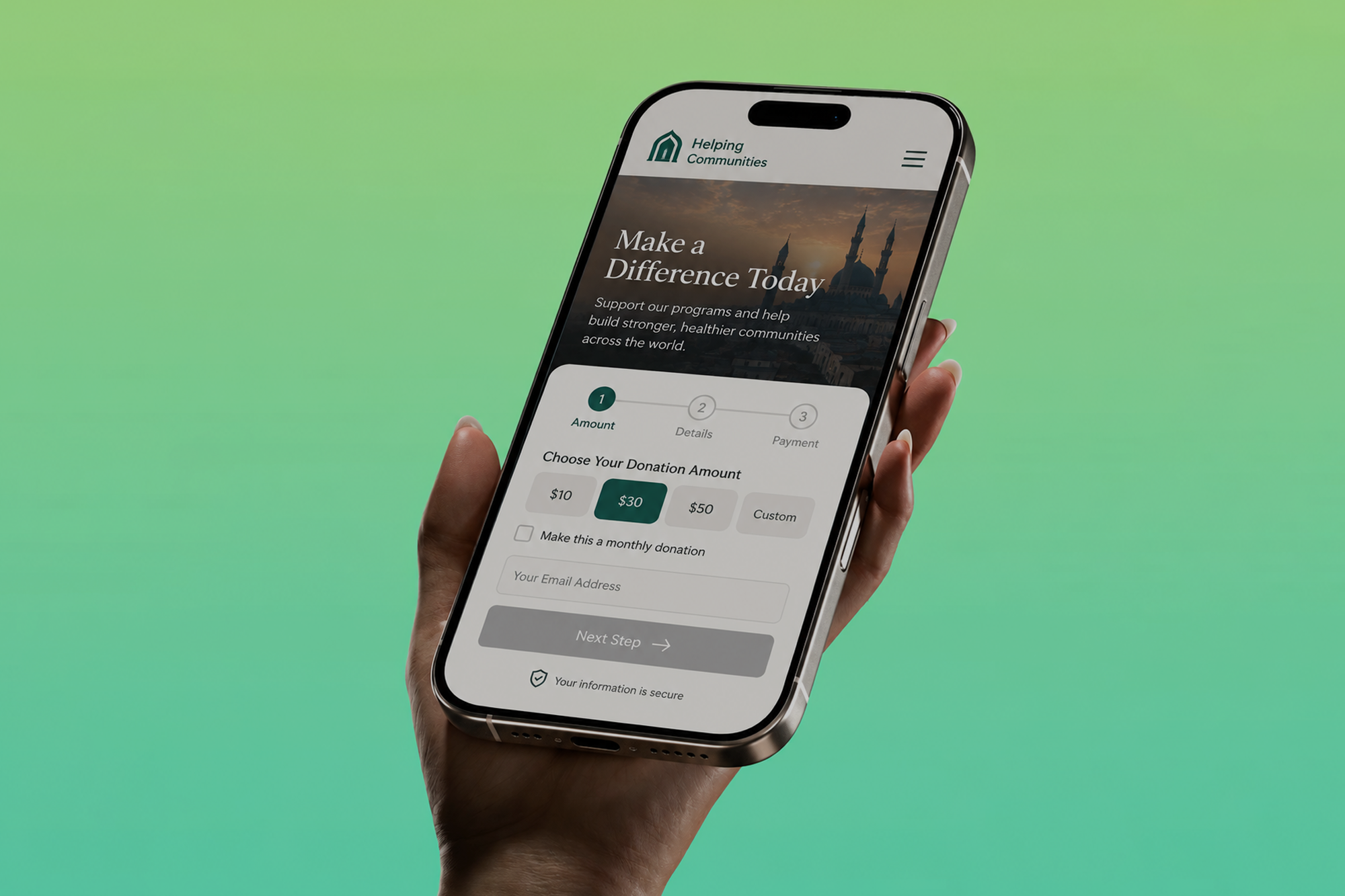
You built the website. You have a cause worth giving to. You are running campaigns during Ramadan, promoting your Zakat appeals, and sharing compelling stories on social media. Visitors are coming. And yet, the donations are not matching the traffic. If your Islamic nonprofit website is not converting donors the way it should, the problem is almost never the cause itself. It is almost always the website experience, and the good news is that every single issue on this list is fixable.
Why Islamic Nonprofit Websites Struggle with Donor Conversion:
1. The Gap Between Traffic and Giving Is Wider Than Most Realize
Most Islamic nonprofit leaders assume that if the mission is strong and the traffic is decent, donations will follow naturally. The data tells a different story. According to M+R Benchmarks, only 1.6% of website visitors made a donation in 2024, generating an average of just $1.33 per visitor. That means for every 1,000 people who land on your site, roughly 984 of them leave without giving a single dollar. For a faith-based charity counting on peak seasons like Ramadan and Dhul Hijjah to fund the year's operations, that gap is not a minor performance issue. It is a strategic crisis.
Islamic nonprofits face a specific version of this challenge. Their audiences are not just evaluating whether the cause is worthy. They are evaluating whether the organization is trustworthy in a faith context, whether the donation will be handled according to Islamic principles, and whether the experience respects who they are as Muslim donors. When a website fails to speak to those concerns, even the most mission-aligned visitor will click away.
2. What Muslim Donors Look for That Generic Charity Sites Miss
A Muslim donor arriving at your website is not only asking, "Is this a good cause?" They are asking whether the Zakat given here is Zakat-eligible, whether the Sadaqah Jariyah they want to give will be applied correctly, and whether the organization has the Islamic credibility to be trusted with their ibadah-motivated giving. A website that treats these as footnotes, or worse, ignores them entirely, is leaving conversions on the table.
Generic nonprofit website templates were not built with this audience in mind. They address donor hesitation with trust badges and charity ratings, but they rarely address the faith-layer of trust that Muslim donors need before they click donate. Closing the conversion gap for an Islamic nonprofit starts with recognizing that the donor experience must be culturally and spiritually aligned, not just technically functional.
3. Unclear Zakat and Sadaqah Categorization
One of the most damaging donor conversion issues Islamic charities face is ambiguity around how donations are categorized. Muslim donors who intend to give Zakat have a religious obligation to ensure their money goes to eligible recipients. If your donation page does not clearly separate Zakat-eligible funds from Sadaqah and general donations, many donors will hesitate or abandon the form entirely. It is not that they do not trust your mission. It is that they cannot verify, from your website, that their act of worship will be valid.
This is a conversion problem with a simple structural fix: every donation form for an Islamic nonprofit should clearly label fund categories, explain Nisab thresholds if relevant, and offer a brief explanation of eligibility. Donors who feel their religious obligations are respected on your platform convert at significantly higher rates than those left to guess.
4. Friction in the Donation Form Itself
The donation form is where intention turns into action, and it is where most Islamic charity websites lose donors who were ready to give. According to M+R Benchmarks, the average conversion rate for nonprofit donation forms was 11% for desktop visitors and 8% for mobile donors in 2025. Every unnecessary field, every confusing payment option, and every slow-loading step on that form is a direct cost to your fundraising revenue. Islamic nonprofits often compound this issue by adding custom fields for donor-specific religious information without streamlining the rest of the experience.
The fix here is ruthless simplification. Ask only for what you need. Offer multiple payment methods including options familiar to Muslim donors across different geographies. Make the mobile experience as frictionless as the desktop one, especially given that a large share of your audience will be giving on a phone during Jumu'ah reminders or late-night Ramadan scrolling.
5. Missing Trust Signals That Matter to Faith-Based Audiences
A significant driver of donor conversion issues for Islamic charities is the absence of trust signals that resonate with a Muslim audience specifically. Generic nonprofits can lean on Charity Navigator ratings and BBB accreditation. Islamic nonprofits need those same signals, but they also need Islamic credibility markers: endorsements from scholars or community leaders, transparency about how Zakat is distributed, financial reporting that shows compliance with Islamic principles, and visible accountability to the communities being served.
69% of donors worry their information could be hacked when giving to a new charity. Muslim donors carry those same concerns, and they add a layer on top: they need assurance that the organization they are trusting with their fard or voluntary giving has the Islamic legitimacy to receive it. A website that does not visibly address these concerns is not just missing conversions. It is actively creating doubt.
6. Weak Storytelling and Vague Impact Communication
An Islamic nonprofit's website that describes its work in abstract programmatic language is missing the emotional and spiritual trigger that moves a Muslim donor to act. Donors inspired by the concept of Sadaqah Jariyah want to see the ongoing impact of their giving. Donors fulfilling Zakat want confirmation that real, eligible people were helped. Donors giving in memory of a loved one want to feel the weight of that act honored on your platform.
Storytelling for Islamic nonprofits is not just a content marketing technique. It is a form of dawah. They are seeing proof that their worship has a lasting, tangible form. Weak or vague impact communication is one of the most underestimated donor conversion issues Islamic charities deal with, and it has a direct line to bounce rate.
7. Poor Mobile Optimization During Peak Giving Moments
Muslim donors do not give exclusively at desks. They give after Friday prayers when a reminder lands in their inbox. They give at 3am during the last ten nights of Ramadan when the spiritual urgency is at its highest. They give while watching a fundraising livestream on their phone. If your Islamic nonprofit website is not fully optimized for mobile, you are consistently failing at exactly the moments when donor intent is strongest.
Mobile optimization for an Islamic charity website goes beyond responsive design. It means fast load times, one-tap payment options, a donation form that does not require pinching and zooming, and messaging that lands emotionally on a small screen in a few seconds. The visitors most likely to convert during Laylat al-Qadr are not going to wait for a slow-loading page.
>> Related Post: 5 Psychology Principles that Nonprofits Can Use to Inspire Donors to Give
How to Fix Nonprofit Website Conversion Optimization for Muslim Donors
Start With Your Donation Page, Not Your Homepage
The most efficient place to invest in nonprofit website conversion optimization is the donation page, not the homepage. Visitors who reach your donation page have already expressed intent. They are not browsing. They are considering giving. According to Fundraise Up, nonprofit donation pages have an average conversion rate of 22%, compared to just 1% for general website visitors. The gap is significant, and it tells you exactly where to focus.
For an Islamic nonprofit, optimizing the donation page means making the fund categorization crystal clear, including an impact statement tied to Islamic values, simplifying the form to its minimum necessary fields, and ensuring the page is as fast and clean on mobile as it is on desktop. A well-optimized donation page alone can double conversion rates without increasing a single dollar of ad spend. That is the most direct path from a website that collects traffic to one that actually converts donors.
Build a Donor Journey That Reflects Islamic Values
Nonprofit website conversion optimization for Islamic charities is not a one-page problem. It is a journey problem. A Muslim donor who discovers your organization through a Zakat explainer article, then finds a donor impact story, and then lands on a donation page that clearly labels Zakat-eligible funds is far more likely to convert than one who arrives cold at a generic giving form. Every touchpoint on that journey should reinforce trust, spiritual alignment, and a sense of urgency grounded in Islamic principles.
The digital marketing strategies your nonprofit uses to bring donors to your site must be matched by a website experience that continues the conversation in the same tone and language. If your ad says "Give your Zakat where it counts," your donation page has to immediately deliver on that promise. Misalignment between what brings a donor to your site and what they find when they get there is one of the quietest but most costly conversion killers.
Use Data to Find Where Donors Are Dropping Off
Most Islamic nonprofits investing in nonprofit website conversion optimization make the mistake of guessing where the problem is rather than measuring it. Installing a basic analytics setup and tracking donor drop-off points across your website takes less than a day and gives you more actionable insight than months of assumption-based tweaking. Look at where visitors are leaving your donation page. Check how long it takes for your forms to load on mobile. See which campaign pages are driving the most donations and reverse-engineer what they are doing right.
Data-driven optimization is not a luxury for large organizations with full technical teams. It is a minimum standard for any Islamic charity serious about converting the audience it is already paying to reach. Understanding the top digital marketing mistakes Islamic nonprofits make with their data and measurement practices is the first step toward fixing conversion at the root level.
>> Related Post: 10 Effective Website Marketing Techniques for Nonprofit Growth in 2026
How AEON Digital Solves Donor Conversion Issues for Islamic Nonprofits
AEON Digital works exclusively with nonprofits and has built a specific track record with Islamic and faith-aligned organizations that need more than generic digital marketing. The team understands that an Islamic nonprofit's website is not just a fundraising tool. It is a representation of the organization's trust, values, and accountability to a community that takes giving seriously. That understanding is built into every project.
From donation funnel audits and donor journey mapping to full website optimization and campaign-specific landing pages, AEON Digital brings the technical capability and the cultural fluency that Islamic charities need to close the gap between their traffic and their giving. The agency has helped Islamic nonprofits move from stagnant online revenue to donor funnel and performance analytics that actually reflect real giving behavior, not just vanity metrics. Whether your organization is running Ramadan campaigns, Zakat appeals, or year-round Sadaqah drives, AEON Digital builds the digital experience that converts the audience you are already reaching.
>> Ready to stop losing donors at the last step? Let AEON Digital audit your donation funnel today.
FAQs
- Why is my Islamic nonprofit website not converting donors despite good traffic?
High traffic with low conversions almost always points to a gap in the donor experience. For Islamic nonprofits, the most common culprits are unclear Zakat and Sadaqah categorization, weak faith-aligned trust signals, a friction-heavy donation form, and poor mobile optimization. Traffic brings visitors to the door. The website experience decides whether they walk through it. - What does nonprofit website conversion optimization mean for a faith-based charity?
It means making changes so more of your existing visitors actually donate. For Islamic charities, that goes beyond shortening forms. It means communicating Islamic credibility, clearly separating Zakat-eligible and Sadaqah funds, using storytelling tied to Islamic giving motivations, and creating a seamless mobile giving experience during peak religious moments. - How do I know which part of my Islamic charity website is causing donor drop-off?
Set up conversion goals in Google Analytics and track your donation funnel step by step. Beyond data, go through your donation form yourself on a mobile device as a first-time visitor. Friction points that cause drop-off usually become obvious within minutes of that exercise. - What trust signals matter most to Muslim donors on a charity website?
Muslim donors need two layers of trust. The first is general: SSL security, transparent financials, and recognized certifications. The second is faith-specific: clear Zakat eligibility information, visible accountability to beneficiary communities, and an explanation of how funds are distributed according to Islamic principles. Both layers matter. - Does mobile optimization really affect Islamic nonprofit donor conversion?
Yes, and the stakes are higher for Islamic charities than for most. A large share of Muslim giving happens during spiritually elevated mobile moments, the last ten nights of Ramadan, after Friday prayers, and during Dhul Hijjah. If your donation page is slow or difficult to complete on a phone, you are failing at exactly the moment donor intent is strongest. - How important is storytelling for nonprofit website conversion optimization?
It is one of the most direct conversion drivers, especially for Islamic charities. When a donor reads about a Sadaqah Jariyah project still running years later, they are not reading a case study. They are seeing proof that their giving has a spiritual life beyond the transaction. Concrete impact stories placed near donation forms consistently outperform abstract program descriptions. - Should an Islamic nonprofit have separate donation pages for Zakat and Sadaqah?
Yes, and it makes a measurable difference to conversion. When a Muslim donor arrives at a single generic donation form, they are forced to figure out on their own whether their intended giving type is even valid there. Separate pages or clearly labeled fund options remove that hesitation entirely. A donor who knows exactly where their Zakat is going is a donor who completes the form. - Can donor conversion issues that Islamic charities face be fixed without a full website rebuild?
In most cases, yes. Clarifying fund categorization, simplifying form fields, adding strong impact statements, improving mobile load speed, and updating payment options can all be done on an existing site. A structured audit usually surfaces the two or three changes that will have the highest immediate impact. - How does Ramadan timing affect nonprofit website conversion optimization strategy?
Ramadan requires a dedicated optimization push, not just more ad spend. Campaign-specific landing pages should be live and mobile-ready before the month begins. During the last ten nights, donor intent spikes sharply, and any friction in the giving experience during that window represents a disproportionate loss of revenue. - How can AEON Digital help improve my Islamic nonprofit's website conversion?
AEON Digital works specifically with nonprofits and faith-aligned organizations. The team offers donation funnel audits, donor journey mapping, and conversion-focused landing page builds with an Islamic cultural context built in. Organizations working with AEON Digital have seen measurable improvements in donation page conversion across Ramadan, Zakat, and year-round giving campaigns.