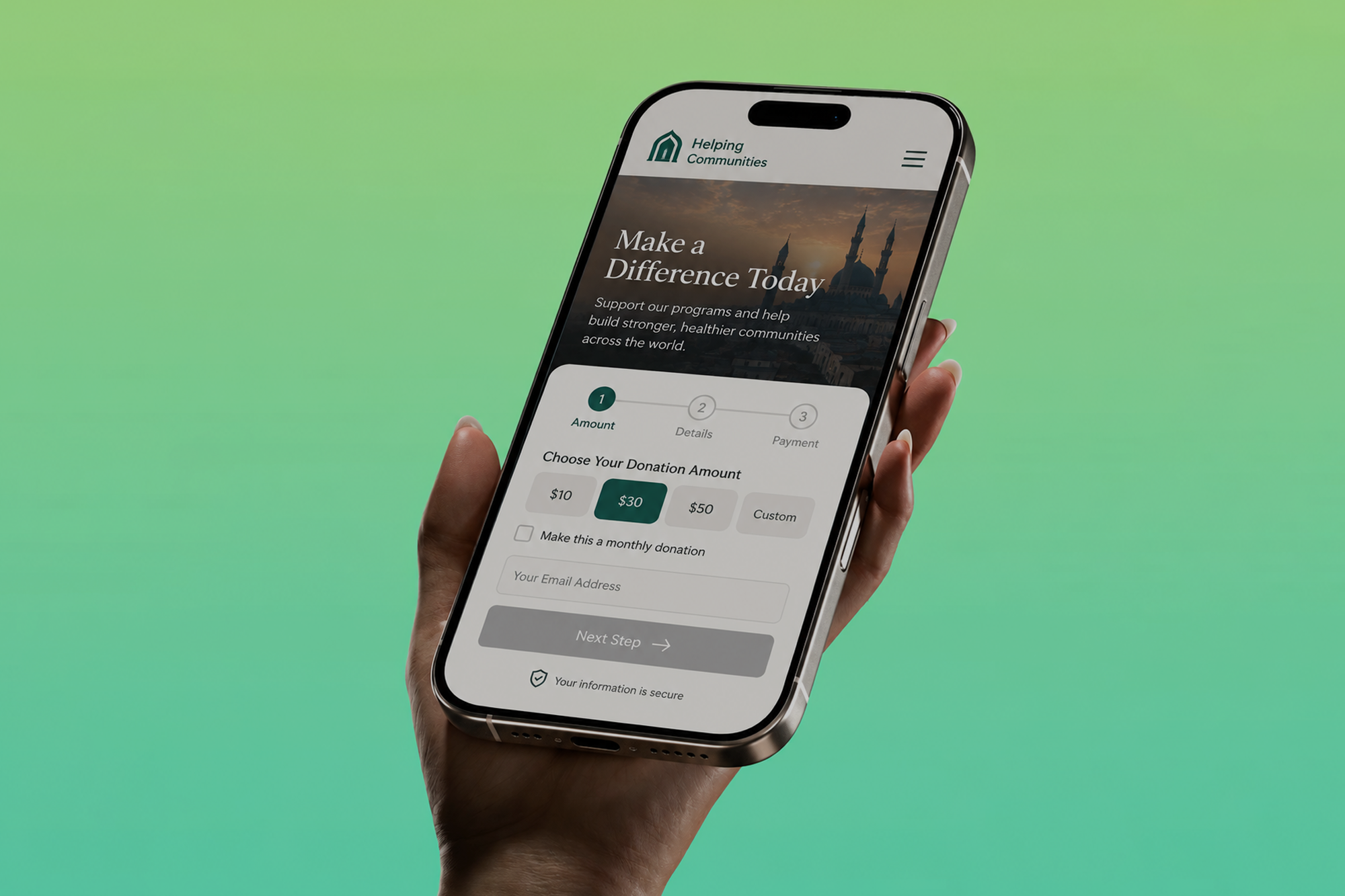
Muslim donors are among the most consistent givers in the world. Generosity is not the problem. What holds most Islamic charities back from meaningful online fundraising growth is a digital presence that was never built to convert that generosity into reliable, recurring revenue. A donor who wants to give Zakat to your organization should be able to do it in under two minutes, on their phone, with complete confidence that their Niyyah is being honored. For most Islamic charities in 2026, that experience does not yet exist. This guide is about building it.
Why Most Islamic Charities Struggle to Increase Online Donations
The honest answer is that most Islamic charities were built around community relationships and in-person trust, not digital infrastructure. A masjid announcement during Ramadan, a table at the Eid fundraising dinner, a trusted sheikh endorsing a cause from the minbar, these are the channels that historically moved the needle, and they worked. What changed is where Muslim donors, particularly younger ones, now make their giving decisions. That shift happened faster than most Islamic organizations were prepared for, and the gap between where donors are and where Islamic charities meet them is where online revenue gets lost.
The second, less obvious issue is seasonal dependence. The vast majority of Islamic charities generate most of their annual online donations during Ramadan and treat the rest of the year as a holding pattern. That model creates a fragile fundraising structure where a single underperforming campaign can devastate the whole year. According to the Fundraising Effectiveness Project, converting a first gift into a second remains the most consequential unsolved problem in nonprofit fundraising, and for Islamic charities running Ramadan-heavy strategies, the window to make that conversion before a donor goes cold is shorter than most realize.
Fixing this is not about outspending larger organizations or running more ads. It is about building the digital systems, the donation pages, the email sequences, the year-round content, that turn one-time Ramadan donors into people who give with you every month because they trust you, feel connected to your mission, and never have to think twice about where their Sadaqah is going.
>> Related Post: Best Digital Marketing Agencies for Islamic Nonprofits in 2026
How to Increase Online Donations for Islamic Non-profits in 2026/2027:
1. Build a Donation Page That Earns Trust Before It Asks for Money
The donation page is where Islamic charity fundraising online either works or falls apart. Most organizations underestimate how much friction exists on their current pages and how much that friction costs them in lost donations. A slow-loading page, a single generic "Donate Now" button with no fund breakdown, and no clear explanation of where the money goes are enough to lose a Zakat-conscious donor who arrived ready to give. Muslim donors giving obligatory Zakat are not just making a financial decision. They are fulfilling a religious duty, which means their threshold for trust is higher than it is for casual giving.
The baseline your donation page needs to meet is this: separate, clearly labeled campaign categories for Zakat, Sadaqah, and any project-specific funds; an embedded Zakat calculator so donors can determine their obligation without leaving your site; transparent disclosure of how administrative fees are handled; and an immediate automated receipt that serves as documentation. None of this is technically complex. All of it signals to a Muslim donor that your organization takes the Amanah of their funds seriously. That signal is what converts a visitor into a donor and a one-time donor into a recurring one.
What Your Donation Page Should Cover
The specifics matter here. An Islamic nonprofit donation strategy is not a generic checklist. It is built around the theological expectations your donors bring to every transaction. Your page should address:
- Separate fund categories: Zakat, Sadaqah, Sadaqah Jariyah, and emergency relief, each with a brief explanation of how funds are used
- A Zakat calculator embedded directly on the page, so donors can calculate their obligation without leaving
- A visible monthly giving option framed as automated Sadaqah, not just a recurring payment
- Clear administrative fee disclosure, whether you apply a cap, a percentage, or a 100% distribution policy, say it explicitly
- Shariah compliance credentials or scholarly endorsements, linked or visible, for donors making larger Zakat transfers
2. Make Your Donation Experience Mobile or Lose Half Your Donors
This is not a preference issue. It is a behavioral reality. Muslim donors, especially those under 40, discover causes through Instagram, share them on WhatsApp, and decide to give in the same session on the same device. If your donation form requires them to switch to a desktop to complete the transaction, most of them will not bother. According to Nonprofit Tech for Good, email drives 33% of donations and social media another 29%, and both of those channels are overwhelmingly consumed on mobile. The tap-to-donate experience your donors expect is not a luxury. It is the standard your online fundraising for Muslim charities needs to meet.
3. Stop Treating Ramadan as a Strategy and Start Treating It as a Season
Ramadan is not an Islamic fundraising strategy. It is the peak of a strategy that should run all year. The organizations growing their online donations fastest are the ones using Ramadan as a donor acquisition engine and then working the remaining eleven months to deepen those relationships into recurring giving. That means planning your post-Ramadan email sequence before Ramadan begins, mapping out your Dhul Hijjah campaign in the spring, scheduling your Muharram appeal in the summer, and treating every significant Islamic date as a natural, faith-aligned reason to reconnect with your donor base.
The giving calendar available to an Islamic nonprofit is genuinely rich. The Day of Arafah, Dhul Hijjah's first ten days, the month of Muharram, and the Sadaqah Jariyah cycle that runs year-round are all underused by most organizations. Donors who give during Ramadan are warm. They already trust you enough to have given once. A well-timed Dhul Hijjah appeal with a specific project update and a clear ask takes minutes to send and can reactivate a significant percentage of your lapsed Ramadan donors before they drift to another organization. This is exactly the kind of marketing automation for nonprofits that separates organizations with predictable revenue from those perpetually chasing the next campaign.
4. Use Email the Way It Was Always Meant to Be Used
Email remains the highest-converting digital channel for nonprofit fundraising, and for Islamic charities it carries an additional advantage: it allows you to speak directly to a donor's faith without the noise and distraction of a social media feed. A well-written email that opens with a relevant Hadith, shares a specific beneficiary story, and closes with a single clear ask will outperform a polished campaign graphic on Instagram almost every time, for a fraction of the cost. The key is sending with intention rather than volume.
The email sequences that work for Islamic charity fundraising online follow a simple logic. New donors get a welcome series that explains the organization's mission, Shariah compliance credentials, and impact. Existing donors get regular impact updates tied to their previous contributions, not generic newsletters. All donors get campaign-specific appeals at each major Islamic giving moment, with enough lead time to plan their giving. None of this requires sophisticated technology. It requires a content calendar, a basic email platform, and the discipline to stay consistent when Ramadan is not right around the corner. The nonprofit guide to digital marketing covers this framework in depth and is worth working through before building out your email program.
5. Build Monthly Sadaqah Into Every Donor Conversation
Monthly giving is the single most powerful lever available to Islamic charities looking to build predictable, growing online revenue. The theological case for it is already made. The Prophet, peace be upon him, taught that the most beloved deeds to Allah are those done consistently, even if small. A donor giving twenty dollars a month for ten years contributes more impact and more predictability to your mission than the same donor giving a large one-time gift driven by an emotional moment in Ramadan. The job of your digital fundraising is to help donors understand that and make the monthly option as easy to choose as the one-time option.
Practically, this means the monthly giving option should be the default or at least equally prominent on your donation form, not buried in a toggle below the main ask. It should be framed as automated Sadaqah, not as a subscription. And donors who give monthly should receive a different, elevated communication experience, more personal impact updates, first access to field reports, and an annual Zakat season acknowledgment that makes them feel like insiders rather than transactions. Mastering donor segmentation is what makes this kind of personalized communication scalable, even for small teams.
>> Related Post: Top 7 Digital Marketing Mistakes Islamic Nonprofits Make
Why Transparency Is the Most Underrated Growth Strategy for Islamic Nonprofits
Trust is the currency of Islamic charity fundraising online, and transparency is what builds it. This is not a soft principle. It is a hard competitive advantage. Donors choosing between your organization and another are asking one question above everything else: can I trust that this money reaches who it is meant to reach? The organizations that answer that question clearly and visibly on every page of their digital presence are the ones that grow. The ones that treat fund management as internal business the donor does not need to know about are the ones that plateau.
Transparency in practice means more than publishing an annual report. It means real-time campaign progress bars so donors can see their collective impact building. It means field photo and video updates tied to specific projects, not stock images of suffering. It means a visible policy on how Zakat is distinguished from Sadaqah and how each is distributed. It means naming your Shariah advisory board or scholarly endorsements where you have them.
According to the Global Humanitarian Assistance Report, faith-based donors sustain longer support cycles and higher retention than the general donor population, and the research points to transparency and accountability as the primary drivers of that loyalty. You do not have to be the largest Islamic charity in the world to offer all of this. You just have to be the most credible one in your donor's mind.
>> Related Post: Top 5 Donations Platforms for Islamic Nonprofits in 2026
Why AEON Digital Understands Islamic Charity Fundraising Online
AEON Digital has spent years building digital fundraising infrastructure for nonprofits, including faith-based organizations navigating exactly the gap described in this guide. The work is not generic. It accounts for the theological sensitivities Muslim donors bring to their giving decisions, the seasonal rhythms of the Islamic calendar, and the specific trust signals that move a Muslim donor from consideration to conversion.
AEON has helped nonprofits grow from hundreds of dollars in monthly online donations to six-figure fundraising operations by focusing on the fundamentals: a donation experience that earns trust, an email program that stays consistent, and a content strategy that keeps donors connected to the mission between major campaigns.
If your Islamic charity is ready to build the digital foundation that your mission deserves, this is the conversation to have now, before Ramadan, before your next campaign, and before another year passes with a donor base that is ready to give more than you were set up to receive.
>> Your donors are ready. Is your digital strategy? Let AEON Digital help you build one that works all year.
FAQs
- What is the biggest reason Islamic charities struggle to grow online donations?
Most lack optimized donation pages, clear fund separation, mobile design, and donor follow‑up. - How should an Islamic charity separate Zakat and Sadaqah?
Create distinct funds with clear explanations. Zakat must follow Quranic categories; Sadaqah can support wider projects. - How important is recurring giving online?
Recurring monthly Sadaqah builds stable revenue and reduces reliance on seasonal campaigns. - Which digital channels work best for fundraising?
Email converts best, social builds awareness, WhatsApp drives community giving, and SEO sustains long‑term traffic. - How do you keep donors engaged outside Ramadan?
Share field updates, impact stories, and educational content year‑round to keep donors connected. - Does SEO matter for Islamic charity fundraising?
Yes. Ranking for Zakat and Sadaqah searches captures donors with high intent and builds lasting traffic. - What should an email sequence look like after a first donation?
Send a receipt immediately, a project story within days, and introduce monthly giving within weeks. - How does transparency increase donations?
Showing fund allocation, Shariah oversight, and real project photos builds trust and drives conversions. - What role does social media play in donations?
It builds trust and emotional connection through consistent impact content, leading to stronger donor relationships. - When should an Islamic charity plan digital fundraising strategy?
Plan months before Ramadan. Optimize pages, build sequences, and launch recurring giving early for growth.